
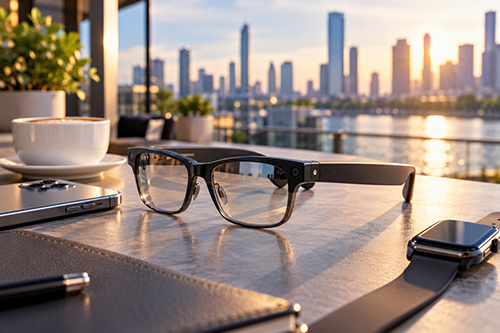
Camera-Free AI Glasses Are Becoming a New Growth Category
The smart glasses market is becoming more diversified.
While camera-equipped AI glasses continue to attract attention, another category is growing quickly: camera-free AI audio glasses.
These products focus on open-ear audio, voice interaction, phone calls, translation, navigation, and AI assistance without including a camera. For many users, this creates a simpler and more privacy-friendly wearable experience.
For distributors, retailers, and private-label brands, this trend creates a new opportunity to target customers who want smart features without the concerns associated with wearable cameras.
Why Camera-Free Designs Are Gaining Attention
One of the biggest advantages of camera-free smart glasses is simplicity.
Without a camera module, manufacturers can potentially reduce product complexity and create frames that look more like traditional eyewear.
This can improve:
Wearing comfort
Product weight
Frame appearance
Battery efficiency
Privacy perception
Everyday usability
For customers who mainly want music, calls, translation, or voice assistance, a camera may not be necessary.
This is especially relevant for office environments, commuting, business communication, schools, and other situations where camera-equipped glasses may create privacy concerns.
Open-Ear Audio Remains a Core Function
Audio continues to be one of the most practical smart glasses functions.
Unlike traditional earbuds, open-ear smart glasses allow users to listen to music, calls, or voice assistance while remaining aware of their surroundings.
This makes them suitable for:
Walking
Commuting
Travel
Office work
Cycling
Outdoor activities
Daily communication
For brands, open-ear audio also provides a clear and easy-to-understand product value proposition.
Customers do not need to learn a new type of display or interface. They can simply wear the glasses and use familiar functions such as Bluetooth audio and voice control.
AI Voice Interaction Expands the Use Case
The addition of AI makes audio glasses more useful than traditional Bluetooth eyewear.
Instead of only playing music and handling calls, AI-enabled audio glasses can potentially support:
Voice assistants
Real-time translation
Information queries
Navigation guidance
Message assistance
Scheduling
Hands-free communication
This allows camera-free smart glasses to become a more intelligent everyday wearable rather than just an audio accessory.
For B2B buyers, the difference between basic Bluetooth glasses and AI-enabled audio glasses may become increasingly important.
Privacy Can Become a Selling Point
Privacy is becoming a larger issue in the smart glasses industry.
As camera-equipped glasses become more common, consumers and regulators are paying more attention to recording indicators, consent, and wearable camera use in public spaces.
Camera-free smart glasses can provide a different market position.
Instead of emphasizing content creation or visual AI, brands can focus on:
Privacy-conscious design
Hands-free AI assistance
Open-ear listening
All-day comfort
Everyday communication
This can make the product more attractive to users who want smart eyewear but do not need recording functions.
What This Means for Distributors
For distributors, camera-free audio glasses can help expand product portfolios.
Instead of offering only one type of smart glasses, a distributor can separate products by use case.
For example:
Audio Series
Focused on calls, music, AI, and translation.
Camera Series
Focused on photography, video, and content creation.
Sports Series
Focused on outdoor use, lightweight design, and open-ear audio.
Electrochromic Series
Focused on adjustable lens tint and premium lifestyle applications.
This type of segmentation makes it easier to target different customer groups.
OEM and ODM Opportunities
Camera-free smart glasses also offer strong OEM and ODM potential.
Brands may want to customize:
Frame design
Product colors
Temple shape
Speaker configuration
Microphone performance
Touch controls
Logo placement
Packaging
Accessories
Charging solutions
Firmware
Mobile applications
Language support
For private-label buyers, this means the product can be differentiated without relying on camera specifications.
Style, comfort, audio quality, AI functions, and branding can become the main selling points.
Lightweight Design Could Become More Important
As smart glasses move closer to everyday eyewear, weight and comfort are becoming more important.
Consumers may be willing to wear smart glasses for several hours, but only if they feel comfortable and natural.
Camera-free designs can help suppliers reduce unnecessary hardware and create slimmer frames.
This is especially important for customers who want to use smart glasses throughout the day for work, travel, communication, or entertainment.
Looking Ahead
The future smart glasses market is unlikely to be dominated by one single product type.
Camera glasses will continue to serve visual AI and content creation.
Display glasses will focus on visual information.
Electrochromic glasses will target premium outdoor and lifestyle applications.
Camera-free AI audio glasses may become one of the strongest categories for everyday wearable use.
For distributors, retailers, and private-label brands, this creates an important opportunity.
Products that combine lightweight design, open-ear audio, AI assistance, privacy, and all-day comfort could become increasingly attractive as smart eyewear adoption grows.