
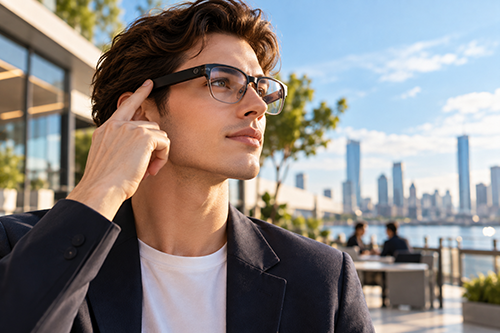
Google has confirmed an important detail about its upcoming intelligent eyewear: the company’s first Audio Glasses will support both Android and iOS devices.
At Google I/O 2026, the company announced that its first audio-based smart glasses, developed with partners including Gentle Monster, Warby Parker, and Samsung, are scheduled to arrive in fall 2026. Google also confirmed that these products will be compatible with both major mobile operating systems.
For the smart glasses industry, this is more than a technical detail.
It signals that cross-platform compatibility may become increasingly important as smart eyewear moves toward broader consumer adoption.
Why Android and iOS Compatibility Matters
Smart glasses are closely connected to smartphones.
Users rely on phones for Bluetooth connectivity, apps, media synchronization, firmware updates, AI services, and account management. If a pair of smart glasses only works with one ecosystem, the potential customer base can be significantly limited.
By supporting both Android and iOS, Google is positioning its first Audio Glasses as a more universal wearable product.
For distributors and retailers, this could simplify product positioning.
Instead of offering separate products for different smartphone users, one smart glasses model may be able to serve a much wider range of customers.
Smart Glasses Are Becoming Extensions of the Smartphone
Google describes its intelligent eyewear as devices designed to deliver useful assistance without requiring users to constantly reach for their phones.
The company has demonstrated functions such as:
Getting directions
Sending messages
Taking photos
Listening to music
Making calls
Accessing phone apps
Using Gemini for hands-free assistance
Google’s Android XR strategy includes two main categories: Audio Glasses, which provide spoken assistance, and Display Glasses, which can show visual information directly in the user’s field of view.
This suggests that smart glasses are increasingly being designed as an extension of the smartphone rather than a standalone replacement.
Cross-Platform Compatibility Can Expand B2B Opportunities
For global distributors and private-label brands, compatibility can directly affect market potential.
Different regions have very different smartphone ecosystems.
Some markets are dominated by Android devices, while others have a much higher share of iPhone users.
A product that supports both platforms can therefore be easier to sell across multiple countries.
This is especially important for brands that want to use one product line across Europe, North America, Southeast Asia, the Middle East, and other international markets.
What Wholesale Buyers Should Evaluate
For B2B buyers, simply seeing “Android & iOS compatible” in a specification sheet is not enough.
A better product evaluation should also include:
Bluetooth connection stability
Companion app availability
Media synchronization
Firmware update support
Camera file transfer
Call compatibility
AI feature availability
Language support
App permissions
Background connection performance
Two products may both claim cross-platform compatibility but provide very different user experiences.
For distributors, these differences can affect customer satisfaction, product reviews, return rates, and long-term brand reputation.
Software Is Becoming Part of the Product
The smart glasses market is also gradually shifting from hardware-focused competition toward a combination of hardware and software.
For example, camera glasses often rely on mobile apps to transfer photos and videos.
Translation glasses may use apps to manage languages and AI translation functions.
Audio glasses may use companion software for touch controls, sound settings, device management, and firmware upgrades.
As a result, buyers should increasingly evaluate the software experience together with the physical product.
A well-designed pair of smart glasses with a poor mobile app can still create a weak overall user experience.
New Opportunities for OEM and ODM Projects
Cross-platform demand is also likely to influence OEM and ODM customization.
In the future, customization may extend beyond:
Logo
Packaging
Frame colors
Lens options
Accessories
and increasingly include:
Branded mobile apps
Customized user interfaces
Multi-language software
Firmware functions
Android and iOS optimization
AI integration
Cloud services
For private-label brands, software differentiation could become just as important as physical product differentiation.
Smart Glasses Are Becoming Part of a Larger Wearable Ecosystem
Google is also expanding how smart glasses interact with other wearable devices.
In July 2026, Google revealed that compatible Wear OS watches will be able to control upcoming smart glasses using hand gestures.
This shows that future smart glasses may increasingly work as part of a connected ecosystem:
Smart Glasses + Smartphone + Smartwatch + App + AI
For the industry, this could become a major competitive direction.
Looking Ahead
Google’s decision to support both Android and iOS with its first Audio Glasses sends a clear signal.
As smart glasses move toward mainstream adoption, compatibility, software experience, and ecosystem integration may become increasingly important alongside traditional hardware specifications.
For distributors, retailers, and OEM/ODM brands, product selection should therefore consider not only what the glasses can do, but also how smoothly they work with the devices customers already use.
The next generation of successful smart glasses may be defined by one key principle:
Better connectivity creates a better user experience.