
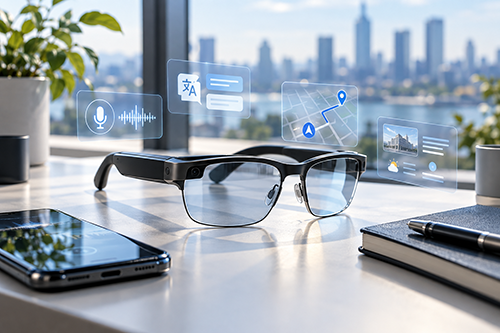
Google’s Android XR Smart Glasses Are Coming This Fall
The smart glasses market is approaching another important milestone.
Google has confirmed that its first Android XR-powered intelligent eyewear will begin launching in fall 2026. The first products will focus on audio-based assistance, while display-equipped models will follow as the Android XR ecosystem develops further. Google is working with Samsung, Gentle Monster, and Warby Parker to bring these products to market. blog.google
This is significant for the smart eyewear industry because Google is not positioning these products simply as Bluetooth glasses. Instead, Android XR is designed to combine wearable hardware with Gemini AI, mobile applications, voice interaction, navigation, communication, and contextual assistance.
Audio Glasses Are Emerging as a Major Product Category
Google has divided its intelligent eyewear strategy into two main categories:
Audio Glasses provide spoken assistance directly through the glasses.
Display Glasses add visual information that appears in the user’s field of view.
According to Google, Audio Glasses will arrive first. These products are designed for tasks such as listening to music, making calls, taking photos, getting directions, accessing phone applications, and interacting with Gemini without repeatedly taking out a smartphone. blog.google
This direction is particularly interesting for the wider smart glasses market.
Compared with complex AR display glasses, audio-focused products can offer a more familiar form factor, potentially lower weight, simpler optical structures, and a design that looks closer to traditional eyewear.
For distributors and retailers, this may make them easier to position as everyday wearable products rather than niche technology devices.
Gemini Is Becoming Part of the Wearable Experience
Google is also expanding Gemini beyond phones and computers.
In May 2026, Google announced that Gemini Intelligence would gradually become available across Android devices including watches, cars, glasses, and laptops. The goal is to make AI more proactive and available across different devices rather than requiring users to open a specific application each time they need assistance. blog.google
This is likely to influence how future smart glasses are designed.
Instead of focusing only on hardware specifications, brands may increasingly need to consider how users interact with AI through voice, cameras, audio, and mobile connectivity.
For example, future smart glasses may increasingly support:
Voice-based AI assistance
Real-time translation
Navigation guidance
Hands-free communication
Camera-based visual assistance
Music and open-ear audio
Context-aware information
Smartphone app integration
These capabilities could make smart glasses more useful in everyday scenarios such as commuting, business meetings, travel, shopping, outdoor activities, and multilingual communication.
Fashion and Comfort Are Becoming Core Requirements
Another important signal from Google is its collaboration with established eyewear brands.
Google specifically highlighted that smart glasses need to be stylish and comfortable enough to wear throughout the day. This is why its first Android XR glasses are being developed with Gentle Monster and Warby Parker rather than being positioned only as technology hardware. blog.google
This reinforces a trend that is already becoming clear across the smart eyewear market:
Technology alone is no longer enough.
Consumers increasingly expect smart glasses to look and feel like normal eyewear.
That means frame design, weight, temple thickness, lens options, material quality, and wearing comfort may become just as important as AI functions.
For OEM and ODM buyers, these factors can create new opportunities for product differentiation.
What This Means for Smart Glasses Distributors and Brands
For distributors, retailers, and private-label brands, Google’s Android XR launch could help increase consumer awareness of smart eyewear.
As major technology companies continue investing in this category, more consumers may begin to understand the practical benefits of AI glasses.
However, different markets may require different product types.
Some customers may prefer lightweight audio glasses for communication and music.
Others may prioritize AI camera glasses for content creation.
Business users may value translation and voice assistance.
Outdoor users may prefer sports frames or electrochromic lenses.
This means there is unlikely to be one single winning smart glasses format.
Instead, the market may become more segmented, creating opportunities for brands that can offer products tailored to specific users and scenarios.
OEM and ODM Opportunities Are Expanding
As smart glasses become more mainstream, B2B buyers may increasingly look for ways to differentiate their products beyond basic functions.
Common customization areas may include:
Frame design
Product colors
Lens options
Logo branding
Packaging
Audio configuration
Camera specifications
Battery capacity
Charging methods
Firmware
App functions
Language support
For suppliers, flexible OEM and ODM capabilities can therefore become an important competitive advantage.
The ability to combine stable production with customization may help distributors and brands respond more quickly as the market evolves.
Looking Ahead
Google’s upcoming Android XR smart glasses represent another step toward making AI a more natural part of everyday wearable technology.
With Audio Glasses scheduled to arrive first and Display Glasses expected later, Google is showing that smart eyewear can develop along multiple product paths rather than relying on a single design. blog.google
For the global smart glasses industry, the broader message is clear:
AI, audio, design, comfort, connectivity, and customization are becoming increasingly connected.
For distributors, retailers, and brands, now is an important time to evaluate which smart eyewear categories best match their target customers and how differentiated products can be developed for specific markets.