
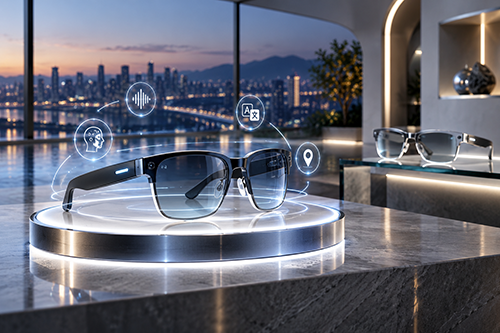
AI Smart Glasses Are Expanding Beyond a Single Product
The AI smart glasses market is entering a new phase.
According to Omdia, global AI glasses shipments reached 4.2 million units in the first half of 2026, representing 127% year-over-year growth. The market is still relatively young, but the category is expanding quickly as more brands introduce new frame designs, product formats, and use cases.
This growth is important for distributors, retailers, and private-label brands because the smart glasses market is no longer defined by one single product type.
Instead, the category is becoming increasingly segmented.
Audio Glasses Are Leading the Market
IDC reported that audio glasses represented 70.3% of XR glasses and headset shipments in Q2 2026, up from 61.9% a year earlier. This category includes smart glasses without displays that focus on functions such as open-ear audio, calling, AI assistance, and hands-free interaction.
The popularity of audio glasses shows that consumers do not necessarily need a complex display to see value in smart eyewear.
For many everyday users, lightweight frames, comfortable wearing, stable Bluetooth connectivity, clear audio, and AI assistance may be more important than advanced visual interfaces.
This creates opportunities for suppliers and brands that can offer practical products at different price levels.
More Product Categories Are Emerging
The market is also becoming more diverse.
Today, smart glasses can generally be divided into several product directions:
AI audio glasses
Camera smart glasses
AI translation glasses
Display smart glasses
Sports smart glasses
Electrochromic smart glasses
Camera-free privacy-focused glasses
Each category serves different users.
Business customers may prefer translation and communication features.
Outdoor users may value lightweight frames, open-ear audio, and sports-oriented designs.
Content creators may prioritize camera functions.
Privacy-conscious users may prefer audio-only smart glasses.
This means there is no longer one universal smart glasses product for every market.
Style and Design Are Becoming More Important
Another major trend is the increasing importance of eyewear design.
Consumers expect smart glasses to look more like traditional glasses and less like technology devices.
This includes:
Slimmer temples
Lighter frames
More color options
Different lens choices
Fashion-oriented shapes
More comfortable all-day wear
Meta recently announced plans to expand its AI glasses portfolio to more than 100 styles across Ray-Ban, Oakley, and Meta Glasses by the end of 2026.
For B2B buyers, this is an important signal.
The future of smart glasses may increasingly resemble the traditional eyewear industry, where style, fit, target audience, and product positioning are just as important as technical specifications.
What This Means for Distributors
For distributors, the expanding product landscape creates both opportunities and challenges.
Instead of choosing one model and selling it to every customer group, distributors may benefit from building a more structured product portfolio.
For example:
Business Series
Translation, calling, meetings, and AI assistance.
Lifestyle Series
Audio, music, voice assistants, lightweight design.
Outdoor Series
Sports frames, polarized lenses, camera functions, longer battery life.
Premium Series
Electrochromic lenses, advanced materials, premium packaging.
This kind of segmentation can help distributors target different customer groups more effectively.
OEM and ODM Customization Will Become More Valuable
As the market becomes more competitive, product differentiation will become increasingly important.
For private-label brands and OEM/ODM buyers, customization may extend beyond adding a logo.
Important areas may include:
Frame shape
Product color
Lens type
Audio performance
Camera configuration
Battery capacity
Charging method
App functions
Packaging
Accessories
Brand materials
A differentiated product can help avoid competing only on price.
For suppliers, the ability to provide stable production together with flexible customization can become a major advantage.
Privacy Is Also Influencing Product Design
Another trend affecting product development is privacy.
Reuters recently reported growing global concern around camera-equipped AI glasses, particularly around discreet recording and user consent. This has increased interest in alternative formats such as camera-free smart glasses and devices with clearer privacy controls.
For brands, this means privacy may become another factor when selecting a product category.
Different markets may respond differently to camera-based smart glasses, so product selection should consider local regulations, user expectations, and usage scenarios.
Looking Ahead
The smart glasses market in 2026 is becoming broader, more segmented, and more mature.
Strong shipment growth shows that consumer awareness is increasing, while the rapid expansion of product styles suggests that competition is shifting from basic functionality toward design, comfort, use cases, and customization.
For distributors, retailers, and global brands, this creates an important opportunity.
Rather than asking only whether smart glasses are a promising category, the more important question is becoming:
Which type of smart glasses best fits your target market?
Brands that can identify clear customer groups and offer differentiated products may be better positioned as the category continues to grow.