
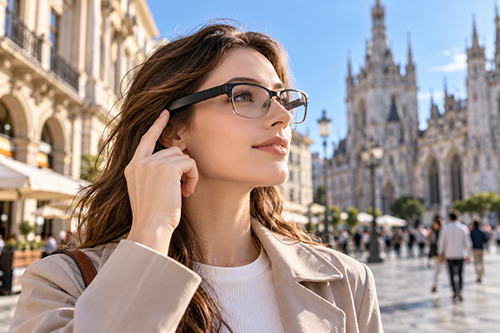
Spatial Computing Glasses Move Closer to the Mainstream
The smart glasses industry is entering another important stage.
While audio and camera-based AI glasses continue to grow, a second category is becoming increasingly important: spatial computing glasses.
In October 2026, XREAL confirmed pricing and preorder details for its new AURA glasses. The device starts at US$1,279 in the United States and combines optical see-through glasses with a separate computing puck running Android XR. The higher configuration is priced at US$1,499.
This launch shows how the smart eyewear market is expanding beyond simple audio, cameras, and voice assistants toward more immersive computing experiences.
From Smart Eyewear to Wearable Computing
Traditional smart glasses usually focus on a limited number of functions such as calls, music, photography, translation, or AI assistance.
Spatial computing glasses take a different approach.
Instead of simply adding smart functions to conventional eyewear, they aim to place digital information, applications, entertainment, and productivity tools directly into the user’s field of view.
XREAL describes AURA as an Android XR spatial computing system with optical see-through displays. The glasses connect to an external computing module that provides processing, connectivity, battery power, and touch-based navigation.
This architecture also highlights one of the biggest engineering challenges in smart eyewear: balancing performance with wearing comfort.
Why Split Computing Matters
Putting processors, batteries, displays, cameras, sensors, and wireless components directly into a pair of glasses can make the product heavy and bulky.
A split-computing design moves some of that hardware outside the frame.
This allows the glasses themselves to remain lighter while still providing more advanced computing performance.
XREAL says the AURA glasses weigh less than approximately 95 grams, while the separate puck handles much of the processing workload.
For the wider smart glasses industry, this is an interesting design direction.
Future products may increasingly choose between two approaches:
All-in-one smart glasses that prioritize simplicity and portability.
Split-computing glasses that prioritize higher performance and richer visual experiences.
Both approaches could serve different customer groups.
Display Technology Is Becoming a New Battleground
Another major difference between spatial computing glasses and conventional AI glasses is the display.
AURA uses transparent optical displays with an approximately 70-degree field of view, allowing users to see digital content while still maintaining visibility of the real environment.
This type of experience can support applications such as virtual screens, entertainment, navigation, productivity, gaming, and interactive information.
As display technology improves, smart glasses may gradually expand from accessories into more capable computing devices.
For distributors and brands, this means that the smart eyewear market may eventually include several clearly separated price and performance levels.
Smart Glasses Are Becoming a Multi-Tier Market
The growing variety of products suggests that smart glasses should no longer be viewed as one single category.
For B2B buyers, the market can increasingly be divided into several levels:
Audio Smart Glasses — calls, music, AI assistants and translation
Camera AI Glasses — photography, video and visual AI
Electrochromic Smart Glasses — adjustable lenses and lifestyle applications
Display Smart Glasses — notifications, navigation and visual information
Spatial Computing Glasses — immersive applications, productivity and entertainment
Each category has different pricing, technical requirements, target customers, and use cases.
This creates more opportunities for distributors to build a product portfolio rather than relying on a single model.
What This Means for Wholesale Buyers
For wholesale buyers, more advanced smart glasses also require a more detailed purchasing process.
Specifications such as battery capacity or Bluetooth version are no longer enough.
Buyers may increasingly need to evaluate display quality, field of view, processing performance, software ecosystem, application compatibility, thermal management, weight distribution, control methods, and long-term software support.
The launch of AURA also shows that high-end smart glasses can reach price levels above US$1,000.
This means distributors need to think carefully about target customers and product positioning before entering the premium XR category.
Opportunities for OEM and ODM Brands
The expansion of spatial computing does not mean every smart glasses brand needs to develop an advanced XR product.
Instead, it demonstrates how quickly the overall category is diversifying.
For OEM and ODM buyers, differentiation can happen at many levels:
frame design, lenses, audio, cameras, battery capacity, software, applications, packaging, charging solutions, and user interaction.
A brand targeting everyday consumers may choose lightweight audio glasses.
A sports brand may focus on open-ear audio and outdoor lenses.
A technology brand may explore displays or more advanced AI functions.
The important point is that smart eyewear is becoming a platform with multiple product directions.
Looking Ahead
The launch of XREAL AURA is another sign that smart glasses are moving beyond experimental products.
Audio glasses are becoming more practical for daily wear, camera glasses are expanding AI capabilities, and spatial computing glasses are beginning to deliver richer visual experiences.
For distributors, retailers, and private-label brands, the opportunity is becoming broader — but product positioning is also becoming more important.
The future smart eyewear market may not be defined by one winning device.
Instead, different products will serve different users based on price, design, AI capability, display technology, comfort, and application scenarios.
For B2B buyers, understanding these segments early could help identify the most suitable opportunities as the market continues to grow.