
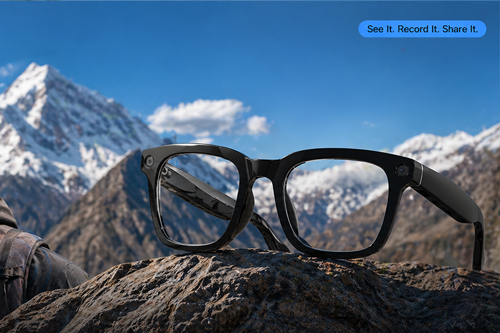
Display-Less AI Glasses Are Leading the Market
The smart glasses market is growing quickly, but the strongest commercial momentum is not coming from complex AR display products.
According to Counterpoint Research, global AI glasses shipments surged in the first half of 2026, with display-less AI glasses accounting for around 96% of total shipments. Counterpoint says these products continue to dominate because they are lighter, more affordable, and easier to integrate into familiar eyewear designs.
IDC’s latest data tells a similar story. In Q2 2026, audio glasses represented 70.3% of XR glasses and headset shipments, up from 61.9% a year earlier, while display glasses accounted for 14.3%.
For distributors, retailers, and private-label brands, this is a very clear market signal.
Consumers Currently Prefer Simpler Smart Glasses
Display-less smart glasses usually focus on practical functions rather than immersive visual experiences.
Typical features include:
Open-ear audio
Hands-free calling
Voice assistants
AI interaction
Camera capture
Real-time translation
Music playback
Navigation assistance
Smartphone connectivity
These features are easier for consumers to understand and use.
They also allow manufacturers to keep products closer to the size, weight, and appearance of traditional eyewear.
This is likely one reason the category is growing faster than more complex AR glasses.
Lightweight Design Is a Commercial Advantage
One of the biggest barriers to smart glasses adoption is still comfort.
Consumers may be interested in AI or AR functions, but if the frame is too heavy, too thick, or too technical-looking, everyday use becomes difficult.
Display-less products avoid many of the optical components required by AR glasses, including waveguides and larger projection systems.
This can help reduce:
Frame thickness
Weight
Power consumption
Manufacturing complexity
Product cost
For B2B buyers, these factors directly affect product positioning and retail price.
Price Matters More Than Feature Count
AR and display glasses can deliver more advanced experiences, but they also tend to be more expensive.
Counterpoint notes that AR & AI glasses remain a smaller niche because of higher costs, lower technology maturity, and bulkier form factors.
This highlights an important lesson for distributors:
More features do not automatically mean better market performance.
In many cases, a simpler product with strong audio, stable connectivity, good comfort, and a clear use case may sell better than a technically advanced but expensive device.
Product Positioning Is Becoming More Important
As the market expands, smart glasses are becoming more segmented.
Distributors may increasingly need to build product lines based on customer needs rather than technical specifications alone.
For example:
Lifestyle Audio Glasses
Focused on music, calls, comfort, and everyday wear.
AI Camera Glasses
Focused on hands-free photography, video, and visual AI.
Translation Glasses
Focused on travel and multilingual communication.
Sports Smart Glasses
Focused on outdoor activities, open-ear audio, and lightweight frames.
Electrochromic Smart Glasses
Focused on adjustable lenses and premium lifestyle use.
This type of segmentation can help brands avoid competing only on price.
What This Means for Wholesale Buyers
For wholesale buyers, the latest shipment data suggests that practical, lightweight smart glasses may currently offer the strongest commercial opportunity.
Before placing bulk orders, buyers should evaluate:
Product weight
Wearing comfort
Audio quality
Bluetooth stability
Camera performance
Battery life
Charging method
App quality
Lens options
Product appearance
Packaging
Certification
After-sales support
A product with balanced performance may be more valuable than one with the longest feature list.
OEM and ODM Opportunities
The dominance of display-less AI glasses also creates strong opportunities for OEM and ODM customization.
Because these products are simpler than full AR systems, suppliers can often provide more flexibility in areas such as:
Frame design
Product colors
Lens options
Speaker configuration
Microphone tuning
Camera specification
Battery capacity
Touch controls
Packaging
Branding
Mobile apps
Language support
For private-label brands, this makes it easier to create differentiated products for specific customer groups.
The Market Is Still Expanding
Omdia reported that global AI glasses shipments reached 4.2 million units in the first half of 2026, up 127% year over year. The firm also noted that growth is being driven by clear consumer use cases such as hands-free photo and video capture, open-ear audio, and AI assistance integrated into everyday frames.
This reinforces the same conclusion:
The market is currently rewarding products that combine practical functions with familiar eyewear design.
Looking Ahead
Display glasses and AR products will continue to improve, but in the near term, display-less AI glasses appear to have the strongest commercial momentum.
For distributors, retailers, and private-label brands, the opportunity is not simply to find the most advanced smart glasses.
The bigger opportunity may be to find the product that best balances:
Functionality
Comfort
Design
Price
Reliability
As smart glasses continue to move into mainstream consumer markets, products that feel like normal eyewear while delivering useful AI functions may remain the most scalable category.